

2026-08-24
A Lighting Designer's View from Both Sides of the Atlantic
Thomas Paterson, internationell ljusdesigner, har under sin sommarvistelse i Sverige reflekterat över skillnader och likheter i synen på ljusdesign i Europa och USA. Ta del av hans tankar och reflektioner här!
As I enjoy the Swedish summer, a time when little artificial lighting is required, it’s a good moment to reflect on the differences I find between Sweden (and Europe in general) and the largest market my team and I work in, North America. The two regions are fairly similar in some ways, modern cities with suburbs and city centers, similar commerce and office environments. And they are distinct in many other ways – historic buildings are common in Europe, rare in the States; European construction operates on performance-based design law, close to self-enforced; the US on explicit directive law and external enforcement. These differences among many others have led to very distinct differences between the design mentalities of the two regions, and exploring them is an interesting topic.
Two major differences drive a lot of the way the two markets function.
In the United States, most luminaire manufacturers use an “ordering matrix” approach to mass customization of fixtures. Each cut sheet had a table where you fill out the features you want – round or square; recessed or surface mounted; DALI, phase, DMX or 0-10V, and so on. You can essentially put together any fixture you want. This is fantastic for well-put-together projects where every fixture runs on the same control type, every trim the same paint finish, and so on. It’s also a massive burden on the factory that has to be able to produce, in short order, an enormous spread of fixtures. We calculated once that one Lucifer downlight specification sheet represented over a quarter million different iterations. Of course, few of them will ever be made, but as a designer, I have massive choice. For the manufacturers, it necessitates a network of sales representatives simply to price a unique configuration no one has asked for before.
By contrast, European manufacturers offer specification codes for a few (or a few dozen) variations on a product, what they think is most likely to sell. This reduces their cost and complexity, allows price sheets to work without consulting the factory, and helps them keep the right fixtures on the shelf for quick shipping. I suspect it’s also behind the often bizarre mix of buttons, switches and dimmers on the walls in mid-market European projects – one fixture is in push-to-dim, another on 0-10V potentiometers, and a third on DALI. It keeps the costs down and shifts the complexity to the project rather than the manufacturer.
When I was coming up in Europe, 25 years ago, there was a lot of discussion with our architect collaborators about honesty in architecture. Expressed concrete, expressed and expressive metal façade structures, etc. I loved that. It often also defined lighting design. The Belgian and Italian lighting manufacturers with their protagonist surface-mounted fixtures for when no concealment was possible. By contrast, most US architecture is “stick built”, plasterboard on frames – so with lots of concealed volume, recessed, concealed fixtures are the order of the day. I find that the two markets are now converging. I suspect because “true” materials like concrete walls aren’t environmentally sophisticated – these days they’re assemblies with insulation and fill between too surfaces, simulacra of “true”. So Europe moves towards greater integration. At the same time, the US is in a phase, defined perhaps by new LED form factors and interior design trends, to surface mount more. Nevertheless, American architects are far more likely to push for tiny apertures and concealed lighting than Europeans. The European love of track lighting is just one representation of this, expressed objects and a comfort with building services being seen.
The other major driver of differences is budget. The US market is so over-engineered to meet UL regulations that fixtures often cost as much as three times as much in the US as in Europe. If the overengineering for fire safety were necessary, Europe would have burned down ten times over by now. It’s excessive. It’s also quite the barrier to entry preventing European manufacturers from entering the US market.
At the same time, the balance of budgets is shifting – particularly in the US, but globally. When I began, we would have budgeted the overhead lighting, probably downlighting, and then estimated some 10-30% of additional budget for feature lighting of various sorts. These days we see two trends – linear tape lighting integrating into millwork adding to budgets – now often exceeding the amount spent on the main area lighting, and area lighting in ever more solutions – from downlights and cylinders through panels, feature elements and so on.
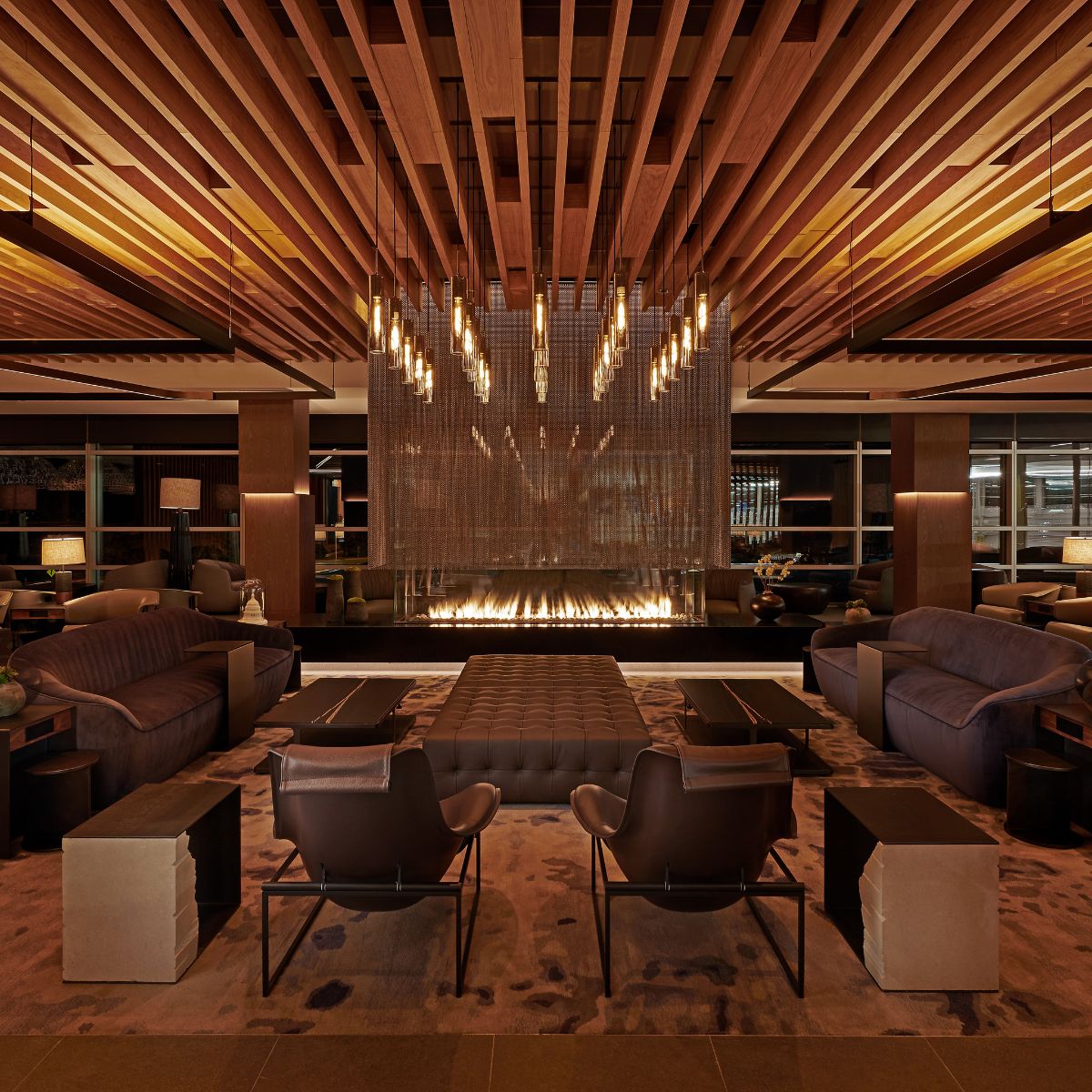
The US has always liked screw-in lamps and uses far less integrated products than Europe. This was often seen as laggardly in Europe, but I’d suggest that it has some huge benefits. A screw-in or plug-in PAR, MR, G or A lamp is relatively easily replaced compared to integrated LED that inevitably leads to fixtures being thrown out at the end of their module life. For all that Zhaga and the like promise commonality, the natural market for commonality is “replacement” LED lamps – simply because the installed base around the world guarantees them a sustainable market for decades to come. Where appropriate, a simple screw in lamp can be the answer.
In both markets I’m saddened to see that we’ve lost some valuable industry knowledge – flicker is back to where it was in the 1980s before Electronic Control Gears came in for fluorescent, and glare is back to the days of exposed lamps – the level of an exposed T40/T12 returned in 40mm LED office strips, and worse, exposed T5/T16 levels of glare in LED tape-in-channel solutions. Balancing that, the available options to avoid glare are also expanding – from black micro-optics to my beloved specular hyperbolic downlights. These now allow dark ceilings to produce brilliantly lit rooms.
Collectively, as the energy costs of lighting fall, and their relative cost compared to environmentally efficient building envelopes collapses, we’re in a time of ever-more lighting integrated into our buildings. We endlessly add more light. Can we learn from each other to do it with careful judgement, treading lightly upon this Earth?
Now, back to my gravad lax and bullar, before I try to find my eye patches to let me sleep.
- Thomas Paterson